Falcons find formula for scientific success with interactive lessons
February 23, 2026
Alexa’s icy encounter with water became a cool example of the scientific knowledge being gained at Northwest High School every day.
Alexa and her Differentiated Biology classmates learned about the body’s healthy safeguards through an interactive project this winter. They acted as scientific detectives to explore why a marathon runner collapsed near the finish line after drinking a large amount of water. The multi-day experiment taught them about carbon dioxide production, glucose regulation and the body’s thermoregulation process in an energetic way.
Alexa and her three partners smiled as they gathered clues from their scientific data. They compared her internal body temperature and her skin surface temperature after she dipped her left hand into containers of cold and warm water. She said projects like this one made Differentiated Biology one of her favorite high school courses.
“You get to hang out with your friends, and you get to learn more things with your friends,” Alexa said. “It’s really fun.”

Fellow ninth graders Rain and Nainoah worked with their groups at opposite ends of the room. Both said that trying out the thermoregulation process for themselves, rather than having a textbook-only discussion, was a good way to gather facts.
“We just keep learning more and more in every class,” Rain said. “It helps us come up with our hypotheses for things, so we know what to do the next time.”
“I’m finding out better ways to take care of myself and take care of others if it ever comes to that situation,” Nainoah said. “This class has been really helpful.”


Northwest science teacher Anton Olbricht said one of his primary goals is to encourage student engagement in his classroom. He said filling their memory banks with large deposits of interactive experiences would serve them well both now and in the future.
“I think part of my philosophy as a teacher is for students to know more than just the science ideas. It’s about remembering the things that they do,” Olbricht said. “When you and I look back at high school, we remember the activities we did in class. I want to provide the experiences for students to be scientists and have favorable memories of that.”
Olbricht is helping Lincoln Public Schools pilot a new curriculum series for Differentiated Biology this year. The course includes a greater scope of reading material, independent study sessions and laboratory investigations. The yearlong class is offered at all eight high schools and the Science Focus Program.
The marathon runner story served as a realistic thread for students to use to unravel new biology information. During the first lesson, the Falcons discovered that exercise increases carbon dioxide production after they blew bubbles into an indicator solution.
The second lesson featured a glucose lab that let them compare acid and base levels to multiple body systems. They followed that up on day three by using thermometers, stopwatches and water containers to learn how the body’s internal regulation system works.
Olbricht said the strategy is more than just a fun way for students to figure out how the body protects people from rapid hypothermia or heat exhaustion. It is also meant to give them more confidence in all of their scientific pursuits.


“There’s a lot of research that shows the engagement with their exploration not only helps them get a deeper feel for the content ideas, but they’re also developing their skills and identifying themselves more as scientists,” Olbricht said. “I think one of the most important things is developing that identity of being a scientist.”
Alexa said the class is doing just that. She is considering becoming an emergency medical technician (EMT) for her full-time career. EMTs work in ambulance services, hospitals, fire departments or event medical teams, and they can advance to flight medicine or paramedic positions. They have strong scientific backgrounds in subjects like biology, anatomy, physiology and trauma management.
“My brother-in-law is an EMT and firefighter, and I’ve always looked up to him,” Alexa said. “I might want to do that too, so studying this is fun.”
The activities are also teaching the Falcons how organization, teamwork and communication are essential for success. Students in all six groups began their investigations by choosing who would be the test subject, directions reader, data collector and data recorder. They then carefully monitored each thermometer measurement and how long each test subject kept their hands in the water.
After tracking the data, they shared their research with other groups on a screen at the front of the classroom. They used the information to answer detailed questions about the investigation in their notebooks. Several spokespeople ended the day by telling everyone what their group felt was the experiment’s main takeaway.
“The inner temperature is honestly just regulating the whole time, so it doesn’t change much, unless if it’s overworked,” Rain said afterwards. “That’s when things can start to go wrong.”

Rain said he was looking forward to turning his Differentiated Biology experiences into cool moments throughout high school.
“It’s helped us learn more about the medical field and how things will work in other science classes,” Rain said. “I think this class will help us in the future.”
Learn how the LPS science curriculum is empowering students to become skilled scientists.
Do you have a story idea? Share it with the LPS Communications Team by filling out this form!
Published: February 23, 2026, Updated: February 27, 2026
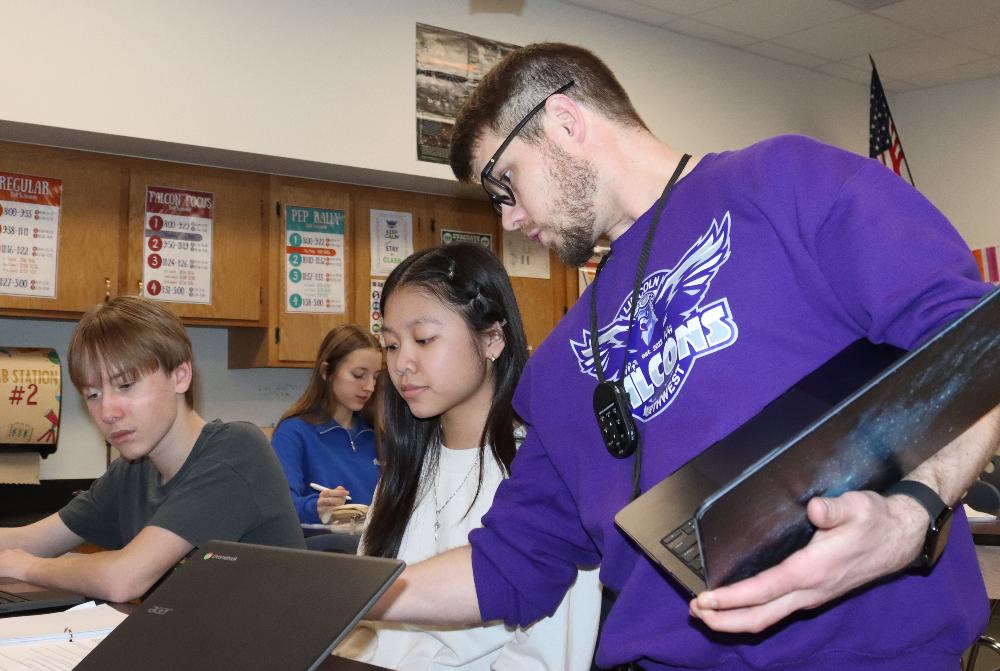
Northwest High School teacher Anton Olbricht looks over a student’s analysis of a thermoregulation science experiment in class. Differentiated Biology students placed their hands in cold and warm water to see how their body regulates their core temperature. Interactive projects like this one are teaching the Falcons many important scientific principles this year.