From Engineer to Educator: Flamme Inspires the Next Generation of Problem Solvers
February 27, 2026
Alex Flamme’s interest in math led her to a career in engineering, but after five years as an engineer in manufacturing automation, she felt a pull toward a different path.
Throughout college, she was involved in groups and jobs that allowed her to work with students. When she began working as an engineer, she realized she missed that environment.
“One day while I was considering transitioning into teaching, I had a thought that in five years I’m going to be a Skilled and Technical Sciences (STS) teacher, and I’m going to look back and think, ‘Of course this is where I belong,’” Flamme said. “That thought helped me decide to make the leap.”
Now, Flamme is more than halfway through her first year as an STS teacher at Lincoln Standing Bear High School, where she teaches engineering, robotics and architecture. Her industry experience directly connects to the skills students develop in her classroom.

“As an engineering student, I was often told that I was getting taught to problem solve,” Flamme said. “With something broad like a mechanical engineering degree, a company is probably not hiring you out of college for your expertise in their industry, but they know you can problem solve. I think it is important for my students to be faced with a problem and know what steps to take to move forward even if one of those steps is asking for help.”
Flamme hopes students leave her classes with a greater appreciation for technical trades and the many careers behind the built environment. She wants them to recognize how engineers, designers and skilled professionals shape the spaces and systems people rely on every day.
Through hands-on experiences, such as modeling a house using industry software like Autodesk Revit and Inventor, students begin to see how the tools they use in class connect directly to real careers and expand their beliefs about what is possible in their future.
Sue Cassata, principal of Lincoln Standing Bear High School, said teachers who come to education after working in other careers bring a unique perspective that helps students connect classroom learning to real-world applications. This then helps the Grizzlies better understand the purpose behind what they are learning.
“Students want to be in Mrs. Flamme's classes because she brings the learning to them,” Cassata said. “The hands-on application and her support in them taking risks as they discover something new are reasons that classes in skilled and technical sciences continue to grow.”
Matthew, a student in Flamme’s architecture class who is interested in becoming a civil engineer, said the course has helped reinforce his interest in the field.
“I’ve always been interested in engineering because my grandpa had a construction company and worked with civil engineers,” Matthew said. “This class has helped because it connects to what I’m interested in.”

He said Flamme supports students at their individual skill levels and creates an environment where students feel comfortable asking questions and sharing feedback.
For Flamme, teaching has become the place where her passion for engineering and working with students come together.
“I’m excited to now be an educator so I can help students develop their skills and share the practical applications of those skills used in industry,” Flamme said.
The vision she once imagined for herself is now a reality, as she helps students discover their interests and build pathways toward their own futures.
Learn how skilled and technical sciences courses are helping LPS students across the city.
Published: February 27, 2026, Updated: February 27, 2026
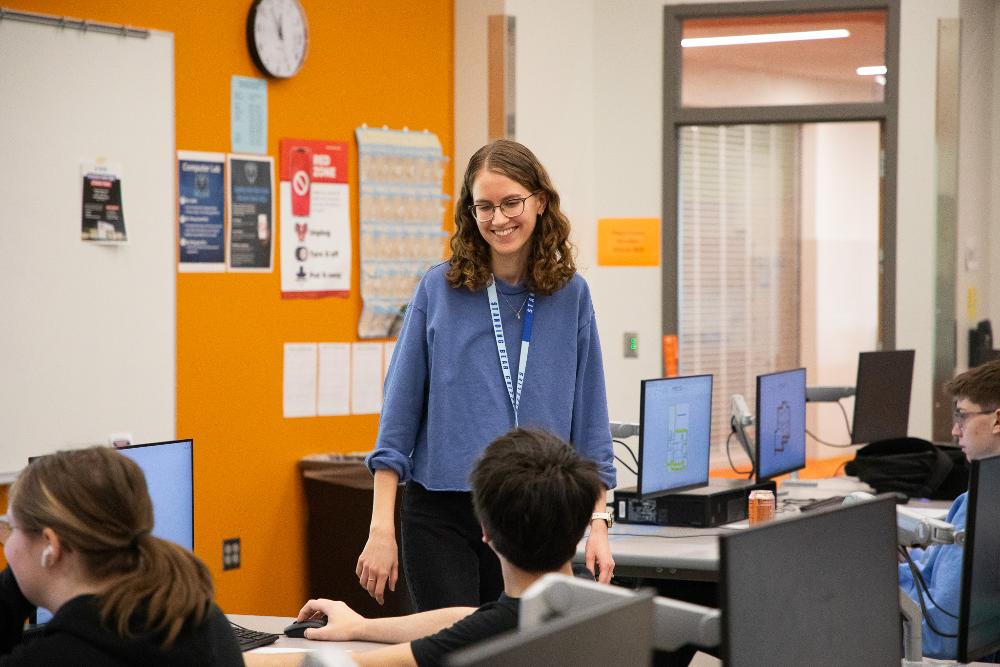
Alex Flamme helps students apply real-world design skills in her architecture class at Standing Bear High School.