Hill celebrates golden anniversary of LPS embryology lessons
March 25, 2026
An idea hatched 50 years ago at Hill Elementary School is continuing to produce golden moments for thousands of Lincoln Public Schools students.
Third graders across the city celebrated the 50th anniversary of the LPS embryology unit this winter. Students at all 40 elementary buildings learned about the life cycle of new chicks during three weeks of memorable lessons. They tracked the progress of chicks from their first day as embryos to fluffy friends in their hands.
Hill third grader Charles said he was happy to see the young animals spring to life. He and other students in Erin Yank’s class enjoyed taking care of six chicks that hatched in an incubator. He said it was neat to know that Hill’s campus was the epicenter of embryology.
“We were the ones that actually started it,” Charles said. “I’m proud of this school that we started it, and the opportunities that we gave to other schools to do it, and I bet the other kids are excited to do it in other schools in third grade.”


Hill Principal Emily Wiebeck said hands-on science activities are important for students like Charles to take part in. She fondly remembered her own chick-rearing experiences at Kahoa Elementary School when she was growing up. She later led the unit for five years as an LPS third grade teacher, which further reinforced the project’s value.
“Every student has different experiences that they bring to school and that they’re allowed to have at home, or are privileged to have at home,” Wiebeck said. “If a student has never been to a farm or never seen a chick in real life, they’re able to be at school and have that experience, but also have all of the learning along with it. You never know what student wants to be a scientist after the embryology program.”
Former Lincoln Board of Education member and Hill Elementary School namesake Ruth Hill founded the LPS embryology program in 1976. She and her husband were co-owners of Lincoln-based Hill Hatchery, and she wanted to provide a special educational gift to Hill students. She asked Richard Earle, the hatchery’s president, if he could come up with a plan.
Earle brought eggs to the school in a glass incubator, and he returned to classrooms for science lessons after the chicks had hatched. The student response was so positive that the program spread to five more LPS buildings the next year.
Soon after, Lancaster County 4-H members began their own embryology program with former Lancaster County Superintendent of Schools Glenn Turner. Rousseau Elementary was among 14 local schools and entities that participated in the 1977 launch. The two programs combined forces after LPS revised its elementary science curriculum in 1981.
The partnership between LPS and Nebraska Extension in Lancaster County has continued to provide lifetime memories. Extension employees Elizabeth Thiltges and Madelaine Vanderbeek visited Yank’s classroom this winter to assist the Hawks during the 21-day unit.

Thiltges brought six brown eggs from Rhode Island Red chickens and six white eggs from White Leghorn chickens on the first day. She told third graders they would be “the mother hens” for their baby animals.
“I like doing this because it gets the kids very excited, and I like seeing that excitement and that spark,” Thiltges said. “It’s just a really cool program.”
Vanderbeek worked with the Hawks during a candling activity nine days later. Students discovered if their chicks had survived the initial stretch of their egg-enclosed formation. Vanderbeek used a flashlight to shine on the eggs, which revealed a large amount of good news. She also gave students tips about caring for their chicks once they hatched.
“It’s important to be gentle because they’re really little at that point,” Vanderbeek said.


Yank said the project teaches students about the rewards that come from being responsible. They spent time each school day tending their eggs.
“Being able to see inside the egg and what’s actually going on, and their hard work of turning the eggs three times a day and making sure it’s the correct temperature and the right humidity,” Yank said. “They see that this is what’s happening. You are actually growing life.”
Thiltges and Wiebeck said the program also provides many scientific and prosocial benefits. Students clear up any misconceptions they may have had about food sources and how animals develop in eggs. They also learn how caring behavior can create healthy outcomes for everyone.
“I have had kids tell me that eggs come from cows, because they’re next to dairy in the grocery stores,” Thiltges said. “I’ve also had quite a few kids when I do this program tell me they’ve never seen a chicken before in their life, so they get pretty excited.”
“They know that we have to be quiet, because these chicks are developing and it takes warm water, but it also takes a really calm environment,” Wiebeck said. “It’s a good reminder to our students that sometimes we need to adjust our practices for the benefit of others.”


Yank relays her own chick memories from her elementary years at Rousseau to her Hill students each winter. She said she is grateful for being part of a 50-year lineage of embryology lessons at LPS.
“Being able to do this every year is really fun,” Yank said. “I think third grade is one of the best grades, especially because we get to do this project.”
Discover how LPS students are hatching scientific knowledge every day in their classrooms.
Do you have a story idea? Share it with the LPS Communications Team by filling out this form!
Published: March 25, 2026, Updated: March 25, 2026
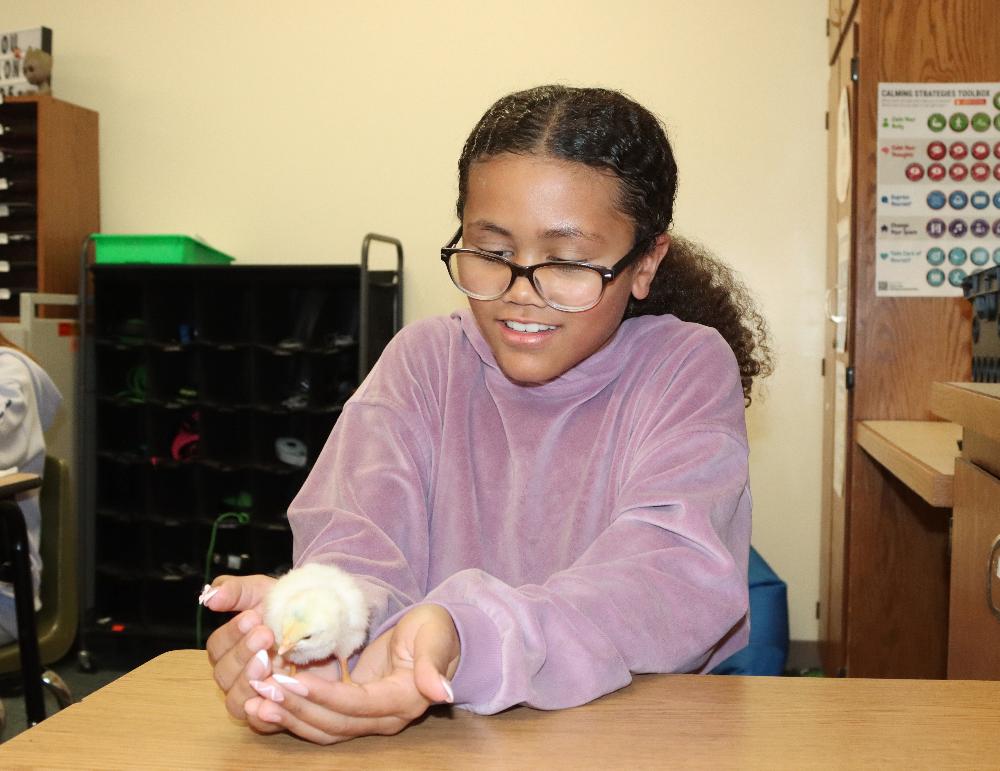
A third grader at Hill Elementary smiles as she holds a new chick in the palm of her hands. She and other students celebrated the 50th anniversary of the LPS embryology unit. The program began at Hill Elementary in 1976.