Grizzlies gain robotics knowledge with new high-tech tools
April 27, 2026
Standing Bear High School students like Michal are programming bright futures with new high-tech tools.
Members of Standing Bear’s Robotics 2 class are among the first Lincoln Public Schools students to use the VEX CTE 6-Axis Robotic Arm. The product teaches them how to code robots to perform precise movements and commonplace tasks in agricultural and manufacturing settings. The device includes six rotational joints that allow the Grizzlies to freely manipulate the arm in many directions.
Michal said it is exciting to step into a new frontier of robotics education in Lincoln. He said the cutting-edge technology is giving him skills that will directly transfer into the workplace.
“Being a high school senior, it really gets me stoked to know that these are things that I’m learning now, and these could be potential jobs for me in the future as well,” Michal said.


Alex Flamme said those reactions are why she is passionate about incorporating technology into her skilled and technical sciences (STS) classrooms. She spent five years as a manufacturing automation engineer before deciding to become a teacher. She said it is essential for her Standing Bear students to learn about STS careers through instruments like the robotic arm.
“I think the industry we are preparing students for is a hidden one,” Flamme said. “Even if a student has a family member in the field, they often have no idea what they do because their work is done in a facility that you can’t visit, like a doctor’s office or a Wal-Mart. But the industry is critical. The top two industries in Nebraska are agriculture and manufacturing. Robotics and automation have a role in both.”
LPS Career and Technical Education Curriculum Specialist Jason Thomsen said the school district wants to prepare students for those expanding careers. Many companies have designed robots that can perform tasks like harvesting fragile crops such as lettuce and strawberries, and others use machines to complete tasks in greenhouses. There are also agricultural robots that can seed and fertilize crops, weed fields and herd cattle.
“It’s exciting anytime we can bring relevant content to students as part of our curriculum,” Thomsen said. “The VEX robotic arms provide students with the opportunity for a hands-on experience that mirrors real-world industrial automation, while also developing problem-solving skills needed for future careers.”
Michal began learning about the profession in the Robotics 1 class. He and other Grizzlies used VEX V5 kits to engineer and design robots to perform various tasks. Robotics 2 students are relying on that knowledge to work on more advanced projects this semester. They are incorporating subjects such as physics, math and computer science into their daily assignments.
The Grizzlies began working with the VEX CTE 6-Axis Robotic Arm curriculum earlier this winter. They moved through assignments such as coding the robot’s movements and teaching it how to transport and palletize objects. They will finish the eight-step unit with a capstone project that focuses on an engineering design process.
Flamme said she has been pleased with the progress in her class. Students have learned that the robotic arm has inputs and outputs that allow programmers to control the jobs it performs.
“You’re moving the robot to a position, and you’re telling it that position that it can then repeat and go to over and over again,” Flamme said.

The class has also discovered new ways to solve problems. The kit includes parts such as a signal tower and base, pen holder tool, dry erase markers and magnetic pickup tool. Students can experiment with different resources and aim to accomplish jobs quickly and efficiently.
Michal said his firsthand experiences with robots have shown him how beneficial they can be. If he had free rein to design an android, what would he want it to do?
“I would want it to solve everyday problems that I have, and I’d want it to do it as fast and best as possible,” Michal said.

In addition to providing technical information about the robotics world, the class is also inspiring students to explore new career paths. The Grizzlies have taken field trips to local manufacturing plants and talked about available opportunities in college robotics courses.
Students have also learned about the growing prospects in computer science fields. For example, the United States Bureau of Labor Statistics projects more than 160,000 new jobs in the software development industry by 2033.
“I would love to be the person that puts (robots) together and especially install them and run programs and run things that they need for desired companies,” Michal said.
Flamme said the new robotic arm is an important tool that the Grizzlies can use to reach those types of educational and occupational goals.
“I feel really excited about robotics because it feels like a problem to tackle,” Flamme said. “So many times you think about the outcome of what a robot does and that it’s cool to look at, but really, when you’re the one trying to make it happen and make it do that, it’s just so many layers of problems for you to solve. There’s a lot of satisfaction when you get to actually make something and make it work.”
Did you know that LPS offers nearly 100 career and technical education courses? Discover more about these learning opportunities.
Do you have a story idea? Share it with the LPS Communications Team by filling out this form!
Published: April 27, 2026, Updated: April 27, 2026
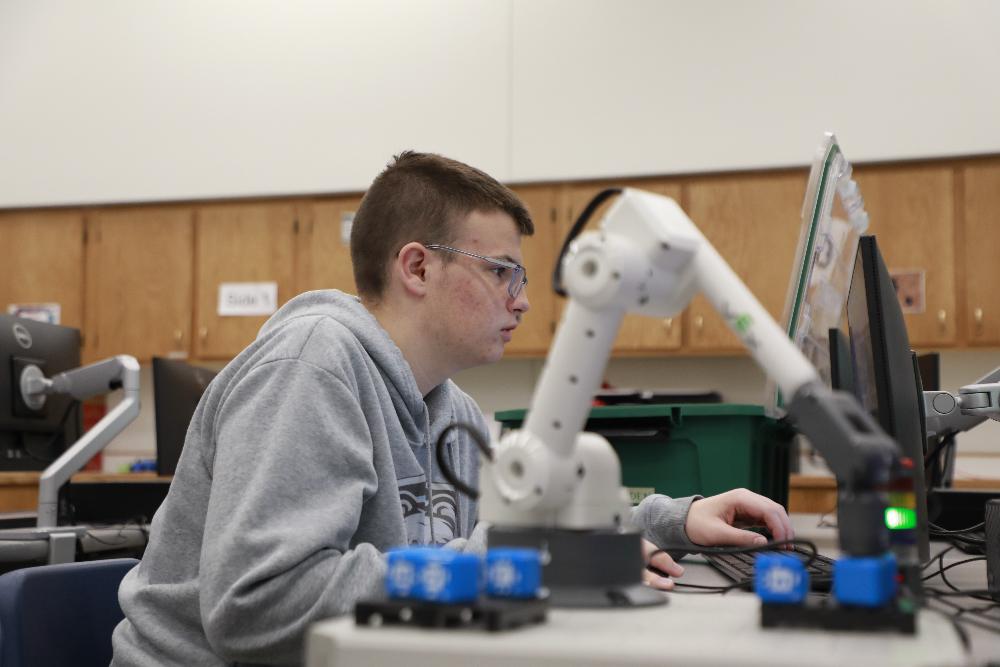
A Standing Bear High School student leans forward as he works with his computer to program a VEX CTE 6-Axis Robotic Arm. Members of Standing Bear's Robotics 2 class are the first LPS students to work with the new technology.