LPS students rely on research talents to excel at state science competition
May 7, 2026
Eight Science Focus Program students received sterling recognition for their research talents this spring at a state science competition.
Science Focus Program (SFP) seniors Avery J, Cara, Elise and Elena and juniors Avery E, Washburn, Leyton and Judie took part in the Nebraska Junior Academy of Sciences (NJAS) State Science Fair. They spoke with judges about their in-depth investigations at the University of Nebraska-Lincoln East Campus Union. Their projects ranged from polymer identification of microplastics along Salt Creek to the impact of air quality on public health in Nebraska metropolitan areas.
Avery E and Elena both said it was rewarding to conduct research that followed the entire scientific process timeline. Avery explored how much carbon different tree species were storing in the Oak Hills neighborhood of Lincoln. Elena examined the long-term effects of a pesticide called rotenone on macroinvertebrate populations in Wagon Train Lake, which is located east of Hickman, Neb.
“The thing I enjoyed most about my research project was the real-world application and the importance behind my results,” Avery said. “I really enjoyed looking at my results and being able to determine what would help our environment in the long run. Storing carbon in organic matter like trees is very important to combating climate change, so being a part of a possible solution was really inspiring for me.”
“I would typically identify 300 to 400 macroinvertebrates at each lake, which took several hours, but looking back at all the hard work I put in, it was worth it,” Elena said. “When presenting at NJAS, seeing all your hard work come together was very fulfilling and makes you feel proud of yourself.”


SFP Administrator Lindsey Roy said those types of projects are a major piece of the focus program’s college preparation efforts. Students hop into the driver’s seat by developing ideas, gathering their own data and partnering with scientists for advice and consultation. SFP teachers guide the process and help with the analysis, but students are at the helm of each investigation.
“This gives students great opportunities to develop the skills of undergrad- and grad-level research throughout their high school experience,” Roy said.
SFP students learn about research fundamentals in their first two years at the focus program. They then delve into yearlong independent projects that are designed to build critical thinking and scientific inquiry talents. They write papers about their results, create professional-level posters and gain confidence by presenting their findings to others.


Avery’s project was one example of the comprehensive nature of each student’s work. She picked eight tree species to study – pine, oak, walnut, elm, maple, locust, poplar and ash – to see if Oak Hills residents had been planting the best carbon-storing varieties. She took physical measurements of 12 trees of each species before plugging those values into a series of biomass equations. The formulas helped her determine the average amount of carbon each tree species could contain.
Avery discovered that nearly 125 maple trees had been planted in the Oak Hills neighborhood. Elm was the only other species that had more than 25 trees take root in the area. However, maple ranked sixth on the list of average carbon-storing capacity. The most effective tree was poplar, which was one of the least-planted varieties in the area.
“I found a clear disconnect in the results, as the trees that were the most abundant did not store much carbon, and the ones that did store a lot of carbon were not as present in our urban landscape,” Avery said.
Avery said she was fascinated by both the outcome and the overall data collection work. She began working on the topic in August and wrapped up her research in February.
“Through this process, not only did I learn a lot about trees and carbon, but I also learned a lot about graphs, scientific processes and what it really takes for a project to come together in a paper,” Avery said. “All of the different aspects and pieces that go into the paper itself were interesting to see, and I was able to learn how to conduct a field study that proved or disproved a hypothesis.”


Elena also incorporated a meticulous data gathering system. She learned that Wagon Train Lake had been treated with rotenone in 2022 to remove invasive fish. She was curious how those waters compared with Stagecoach Lake, which had not been treated with the pesticide. Stagecoach is located south of Hickman.
After collecting species like snails, mayflies and beetles with kick-net sampling, Elena analyzed the biodiversity of both lakes with multiple measurement tools. She found that pollution-sensitive species had begun to recover in Wagon Train, but the overall ecosystem was less diverse than Stagecoach. This meant Wagon Train had not yet fully recovered from the pesticide application.
Elena said it was fun to see her efforts produce academic fruit in the form of a 76-page paper. She said her SFP background would be a major asset for her in her scientific career.
“I want to be a wildlife biologist and potentially become a professor one day,” Elena said. “I believe all the research skills, like how to write a research paper, read peer-reviewed articles, present research, come up with a question, etc., will all benefit me and help me feel more confident in conducting research in the future. Whether through research or education, I want to make an impact, and this is a step toward that goal.”
Customize your high school experience! Explore our Science Focus Program.
Do you have a story idea? Share it with the LPS Communications Team by filling out this form!


Published: May 7, 2026, Updated: May 7, 2026
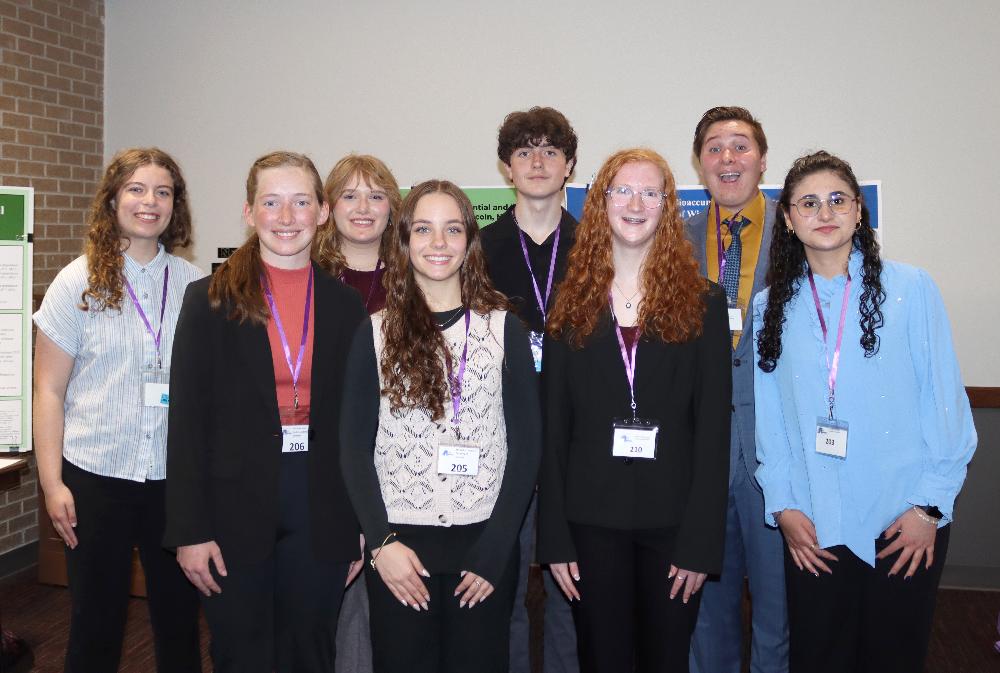
Eight Science Focus Program students smile at the Nebraska Junior Academy of Sciences State Science Fair. From left, Cara, Avery J, Elise, Avery E, Leyton, Elena, Washburn and Judie stand in front of several posters in the University of Nebraska-Lincoln East Campus Union.